
Past Simple Affirmative & Negative ESL Games, Worksheets & Activities
Alicia's Day
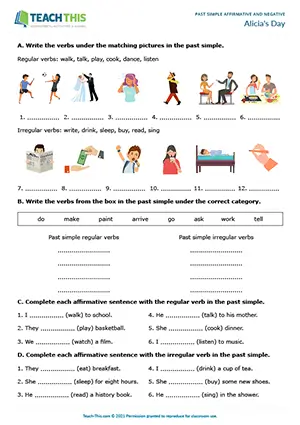
ESL Past Simple Affirmative and Negative Worksheet - Grammar Exercises: Matching, Categorizing, Gap-fill, Rewriting Sentences
In this useful past simple worksheet, students practice regular and irregular past simple verbs in affirmative and negative sentences. First, students match regular and irregular verbs to pictures and...
Guess the Past

ESL Past Simple Affirmative Game - Grammar and Speaking: Sentence Completion, Guessing
In this entertaining past simple game, students complete past simple sentences about their classmates' recent activities and then check if their guesses are right or wrong. First, students complete 'I think...
Last Week Life

ESL Past Simple Affirmative and Negative Game - Vocabulary, Grammar and Speaking: Matching, Forming Sentences, Freer Practice - Group Work
In this past simple game, students practice making past simple affirmative and negative sentences about what they did and didn't do last week. In groups, students...
Mark the Runner

ESL Past Simple Worksheet - Grammar, Reading and Writing Exercises: Identifying, Gap-fill, Writing a Short Paragraph
In this free past simple worksheet, students read a text about Mark the Runner and practice forming past simple affirmative and negative sentences using common regular and irregular verbs...
My Last Summer Holiday
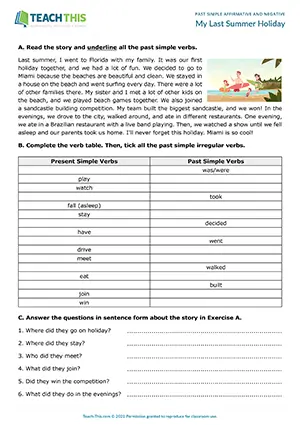
ESL Past Simple Worksheet - Grammar, Reading and Writing Exercises: Identifying, Categorising, Gap-fill, Rewriting Sentences, Writing Short Texts
In this productive past simple worksheet, students practice past simple regular and irregular verbs in their affirmative and negative forms by reading...
Past Simple Sentence Spin
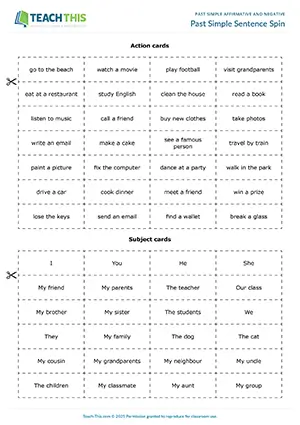
ESL Past Simple Game - Grammar and Speaking: Forming Sentences, Controlled Practice - Group Work
In this enjoyable past simple game, students practice making affirmative and negative past simple sentences from subject and action prompts. In groups, students take turns picking up one action card...
Present to Past
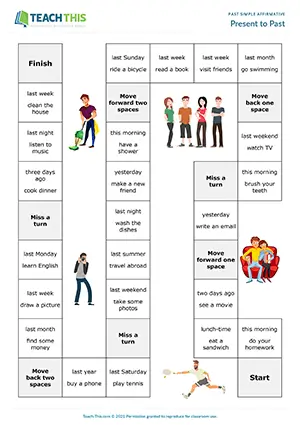
ESL Past Simple Board Game - Grammar and Speaking: Forming Sentences, Changing Verb Forms
This engaging past simple board game helps students practice making past simple affirmative and negative sentences with time expressions. In groups, students take turns rolling the dice and moving...
Restart
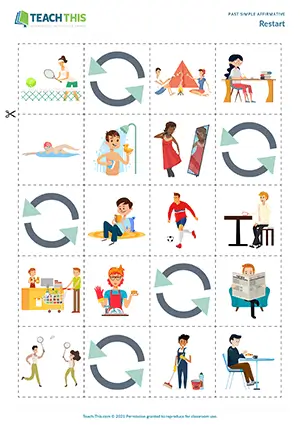
ESL Past Simple Game - Grammar and Speaking: Forming Sentences, Freer Practice - Group Work
In this fun past simple game, students use picture cards to make past simple sentences about what they did yesterday. In groups, the first student lays down a picture card and makes a past simple...
Who Did the Same?

ESL Past Simple Activity - Grammar and Speaking: Gap-fill, Sentence Completion, Freer Practice
In this rewarding past simple speaking activity, students complete affirmative sentences with true information about their past and then mingle to find classmates who did the same things...
A Holiday to Remember

ESL Past Simple Affirmative Negative Worksheet - Grammar and Writing Exercises: Gap-fill, Writing Sentences - Speaking Activity: Discussion - Pair Work
In this holiday-themed past simple worksheet, students practice the past simple affirmative and negative forms of regular and irregular verbs. First, students...
Excuses Excuses
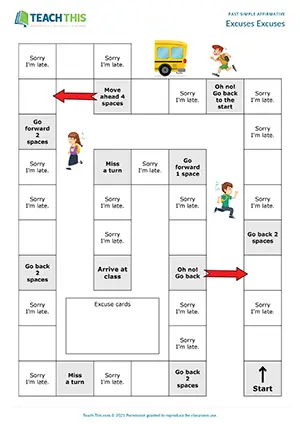
ESL Past Simple Board Game - Speaking: Forming and Reforming Sentences, Freer Practice - Group Work
In this amusing past simple board game, students practice past simple sentences with regular and irregular verbs by making excuses for arriving late to class. In groups, students take turns rolling the...
Gone in 30 Seconds
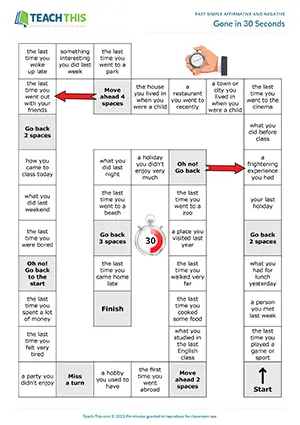
ESL Past Simple Board Game - Grammar and Speaking: Impromptu Speech, Communicative Practice - Group Work
In this free past simple board game, students talk for 30 seconds about everyday topics using the past simple tense as they move around the board. In groups, students take turns rolling the dice and...
Holiday Romance
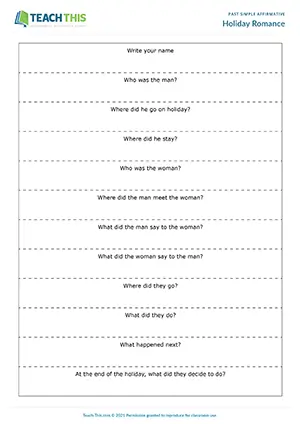
ESL Past Simple Activity - Grammar and Writing: Writing Sentences, Freer Practice - Group Work
In this memorable past simple activity, students invent answers to questions and build a collaborative holiday romance story using past simple sentences. In groups, students answer the...
In the Past
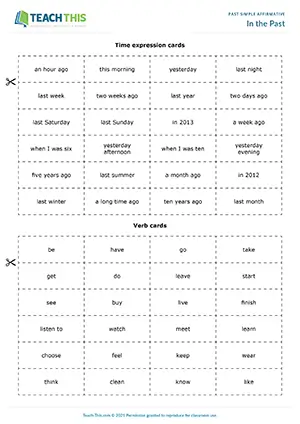
ESL Past Simple Game - Speaking: Forming Sentences, Freer Practice - Group Work
In this engaging past simple game, students use verb and time expression cards to make believable past simple sentences about their own lives and build fluency with common regular and irregular verb forms. In groups, players take turns...
Past Simple Review

ESL Past Simple Worksheet - Grammar Exercises: Categorising, Gap-fill, Rewriting Sentences, Error Correction
In this productive past simple worksheet, students practice using regular and irregular past simple verbs in affirmative and negative sentences. First, students categorise verbs as regular or irregular and...
Past Simple Story Sprint

ESL Past Simple Game - Grammar and Speaking: Forming Sentences, Story Telling, Communicative Practice - Group Work
In this imaginative past simple game, students collaboratively build a story using past simple affirmative and negative sentences while trying to include given verbs for points. In groups, students...
Sentence Building Race

ESL Past Simple Sentence Building Activity - Grammar: Matching, Forming Sentences - Pair Work
In this rewarding past simple activity, students race to build ten compound sentences by joining clauses with 'and' and 'but', making the final clause negative. In pairs, students race to make ten past...
True Lies
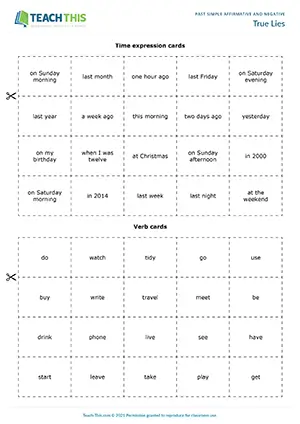
ESL Past Simple Game - Grammar and Speaking: Forming Sentences, True or False, Asking Questions, Guessing - Group Work
Here is a light-hearted past simple true or false guessing game that helps students practice past simple affirmative and negative statements using common time expressions and verbs. In groups, students...
Words to Sentences
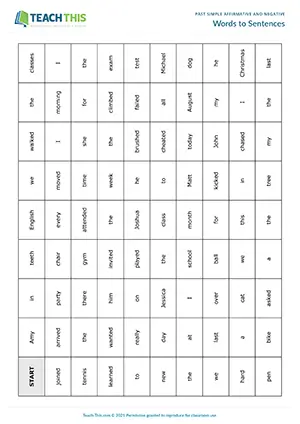
ESL Past Simple Board Game - Grammar and Writing: Writing Sentences, Freer Practice - Group Work
In this creative past simple board game, students collect words and then use them to write as many past simple affirmative sentences as possible, paying attention to -ed pronunciation in regular verbs...
My Memories

ESL Past Simple Fluency Practice - Speaking Activity: Impromptu Speech, Communicative Practice - Group Work
In this enjoyable past simple speaking activity, students use past simple affirmative and negative sentences to talk about personal memories. This activity is best suited for older students or adults and is...
Oh, Really?

ESL Past Simple Game - Grammar and Speaking: Asking and Answering Questions, Freer Practice - Group Work
In this free past simple game, students ask and answer 'When did you last...?' questions from picture prompts and try to give typical past simple affirmative answers using accurate time expressions...
One Day...
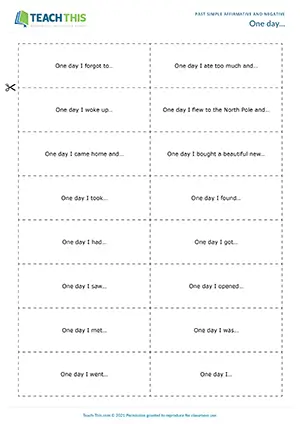
ESL Past Simple Activity - Grammar and Speaking: Forming Sentences, Story Telling - Group Work
In this imaginative past simple speaking activity, students use affirmative and negative past simple sentences to build short mini-stories in a group chain format. In groups, one student begins by picking up...
The Lion and the Mouse

ESL Past Simple Affirmative Negative Worksheet - Grammar, Reading and Writing Exercises: Changing Verb Forms, Gap-fill, Rewriting Sentences
This free past simple worksheet helps students practice affirmative and negative sentences with common regular and irregular verbs. First, students write the...
MythBusters

ESL Past Simple Game - Grammar and Speaking: Gap-fill, Guided Discussion, Guessing - Group Work
In this intriguing past simple game, students complete statements with past simple regular and irregular verbs and then guess which statements are historical facts and which are myths. First, in groups...
Understanding Past Simple Affirmative and Negative
The past simple affirmative states that an action is finished, using -ed for regular verbs ('she called her friend') or a changed form for irregular verbs ('he went to work'). The past simple negative states that an action did not happen, using 'didn't' plus the base verb ('she didn't call', 'he didn't go'). When students add -ed after 'didn't' and produce forms like 'she didn't walked', their sentences signal a basic grammar error that distracts a reader from the meaning.
This page covers past simple affirmative and negative across A1-A2, A2, B1, and B2 levels, with 24 resources ranging from board games and card games to worksheets and speaking tasks, with four available as free downloads.
The table below shows the affirmative and negative structures of the past simple across the main verb categories, with example sentence pairs.
| Verb Category | Affirmative Structure | Negative Structure | Example Pair |
|---|---|---|---|
| Regular verb | subject + base verb + -ed | subject + didn't + base verb | 'She walked to school.' / 'She didn't walk to school.' |
| Regular verb (-e ending) | subject + base verb + -d | subject + didn't + base verb | 'He arrived early.' / 'He didn't arrive early.' |
| Regular verb (consonant doubling) | subject + doubled consonant + -ed | subject + didn't + base verb | 'She stopped the car.' / 'She didn't stop the car.' |
| Irregular verb | subject + past form (no pattern) | subject + didn't + base verb | 'They went to the beach.' / 'They didn't go to the beach.' |
| Verb 'be' (singular) | subject + was | subject + wasn't / was not | 'It was cold yesterday.' / 'It wasn't cold yesterday.' |
| Verb 'be' (plural / you) | subject + were | subject + weren't / were not | 'We were tired.' / 'We weren't tired.' |
When to Use Past Simple Affirmative and Negative
Telling a Personal Story: Speakers use the past simple affirmative to narrate events in sequence, giving each completed action its own moment in time, as in 'I woke up late, missed the train, and arrived at the meeting after everyone else.'
Correcting a Misunderstanding: A speaker uses the past simple negative to deny something the listener assumed happened, shutting down a false assumption directly and without ambiguity, as in 'I didn't say that. He did.'
Contrasting Outcome and Expectation: Writers and speakers pair affirmative and negative past simple sentences to highlight the gap between an expected result and what actually happened, as in 'She studied hard but she didn't pass the exam.'
3-Step Framework for Teaching Past Simple Affirmative and Negative
1. Build the Form Through Controlled Practice: Start with a card-matching activity that requires students to produce accurate sentences before any card can go down. Students take turns turning over a verb card on a weekly chart and, if it matches a word card in their hand, must say a true past simple affirmative or negative sentence about what they did or didn't do at that specific day and time last week. For example, a student turns over the verb 'do' on the 'Wednesday morning' square, matches it with 'homework', and says 'I didn't do homework on Wednesday morning.' The group checks every sentence before the card stays on the board, so accuracy becomes a social expectation from the first turn.
2. Push Fluency With Timed Story-Building: Once students can form the structure reliably, move them into faster, freer production with a group storytelling game. Students take the top three cards from a pile, place them face up, and must form as many past simple sentences as they can using those verbs within 30 seconds. Because students score points only for the cards they use correctly, the activity rewards both form accuracy and speed equally, and the shared story format keeps every student listening.
3. Lock In the Contrast Through Error Correction: Finish with a writing task that makes students notice the difference between the two forms in context. After reading a story containing deliberate mistakes, students respond to each error by writing two sentences: one negative sentence about the mistake and one affirmative sentence with the correct information. That paired response drills the contrast between the forms and gives students a clear model for catching and fixing their own errors.
Common Mistakes with Past Simple Affirmative and Negative
Adding -ed to Irregular Verbs: Students often add -ed to irregular verbs in the affirmative past simple, applying the regular verb pattern to verbs that change form in a different way. Wrong: 'He goed to the supermarket.' Correct: 'He went to the supermarket.'
Omitting 'didn't' and Using 'not' Alone: Students often place 'not' directly before the past verb without using 'didn't', following either their first language's negation pattern or a misapplied rule from present simple sentences. Wrong: 'They not watched the film.' Correct: 'They didn't watch the film.'
Common Questions About Teaching Past Simple Affirmative and Negative
What is a good game for practicing past simple affirmative and negative sentences?
The board game Present to Past gives students a clear structure for practicing both forms. Students roll a dice, move along the board, and form a past simple sentence using the verb on their square and a time expression card. 'Not' squares require a negative sentence with 'didn't' plus the base verb.
What is a useful worksheet for practicing past simple affirmative and negative sentences?
The worksheet Past Simple Review covers both forms in a single lesson. Students categorize verbs as regular or irregular and write their past simple forms, move through affirmative gap-fill and sentence rewriting, and finish with an error-correction task where they identify and fix mistakes in past simple affirmative and negative sentences.
What is a fun past simple board game?
The free board game Gone in 30 Seconds pushes students to produce the past simple under time pressure. Students roll a dice, move along the board, and talk about the topic on their square in the past simple for 30 seconds without stopping. Students who use the wrong tense or stop early go back two squares.
Become a Teach This Member
Get unlimited access to the full library, plus new resources added every week.
Unlimited Resource Access
Download from 3000+ worksheets, activities, and games.
Save 5+ Hours Weekly
Cut lesson prep time with ready-to-use resources, plus teacher notes and answer keys.
Trusted Professional Quality
Classroom-tested, editable resources created by experienced ESL professionals.
Fresh Content Weekly
Get 5 new resources added to the library each week.
Here's what our members are saying...


