Modes of Transport Bingo

Beginner (A1) 25 minutes
ESL modes of transport game preview for beginner A1 students showing vocabulary bingo, matching

ESL Modes of Transport Game - Vocabulary: Bingo, Matching

In this rewarding modes of transport game, students play bingo by listening to the names of 12 modes of transport and matching them to pictures on their bingo cards. Begin the game by reading out a mode of transport from the caller's sheet and...

ESL Modes of Transport Game - Vocabulary: Bingo, Matching In this rewarding modes of transport game, students play bingo by listening to the names of 12 modes of transport and matching them to pictures on their bingo cards. Begin the game by reading out a mode of transport from the caller's sheet and putting a tick beside it to show it has been read. If a student has a matching picture on their bingo card, they put a cross beside it and say the word aloud. When a student has crossed off all nine pictures, they shout 'Bingo!' and read out the nine modes of transport on their card. Check that they are the modes of transport that you have ticked. If the modes of transport are correct, the student wins the round. If the student has made a mistake, the game continues. Play several rounds, making sure students receive a different bingo card each time. If you have more than 12 students in the class, students play the game in groups of four or five. One student is the bingo caller, and the other students take a bingo card each. Students then play the game in their groups using the same procedure as above. Each time a student wins a round, a new student takes on the role of the bingo caller. This continues until all the bingo cards have been used. This resource can also be used with our 'Modes of Transport Flashcards and Worksheet' and 'Modes of Transport Riddles' game.

Modes of Transport Flashcards & Worksheet

Beginner (A1) 30 minutes
ESL modes of transport flashcards and worksheet preview for beginner A1 students showing vocabulary matching, gap-fill, controlled practice

ESL Modes of Transport Flashcards and Worksheet - Flashcards: Eliciting, Drilling - Vocabulary Exercises: Matching, Gap-fill

In this modes of transport resource, students learn the names of 12 common modes of transport and practice them with flashcards and a worksheet. To begin, hold up each flashcard. Point to the...

ESL Modes of Transport Flashcards and Worksheet - Flashcards: Eliciting, Drilling - Vocabulary Exercises: Matching, Gap-fill In this modes of transport resource, students learn the names of 12 common modes of transport and practice them with flashcards and a worksheet. To begin, hold up each flashcard. Point to the picture and elicit the name of each mode of transport. Then model and drill pronunciation chorally and individually. Next, write three question frames on the board: 'What’s this?' 'It’s a/an...' 'Is it a/an...?' 'Yes, it is.' / 'No, it isn't.' and 'Do you go by...?' 'Yes, I do.' / 'No, I don't.' Show the flashcards again and ask different students questions using the sentence frames on the board. Elicit suitable responses as you move around the class. After that, on the worksheet, students match the modes of transport to pictures. Students then complete sentences with the modes of transport. As an extension, students play a quick review game using the flashcards, e.g. 'Land, Air, Water' sorting race, spelling board race, etc. This resource can also be used with our 'Modes of Transport Bingo' game and 'Modes of Transport Riddles' game.

Modes of Transport Riddles

Beginner (A1) 15 minutes
ESL modes of transport game preview for beginner A1 students showing listening, speaking and vocabulary describing, guessing, pair work

ESL Modes of Transport Game - Listening, Speaking and Vocabulary: Describing, Guessing, - Pair Work

In this fun modes of transport game, students review the names of 12 common modes of transport by listening to clues and guessing the answers. In pairs, students take turns picking up a card and reading...

ESL Modes of Transport Game - Listening, Speaking and Vocabulary: Describing, Guessing, - Pair Work In this fun modes of transport game, students review the names of 12 common modes of transport by listening to clues and guessing the answers. In pairs, students take turns picking up a card and reading the first clue to their partner, who tries to guess the mode of transport, using the phrase 'It is a/an...' If their partner guesses the correct mode of transport shown in bold on the card, they score two points. If not, the student reads the second clue for one point. If the mode of transport is not guessed correctly after the second clue, the student reveals the answer and removes the card from the game. The two students then swap roles and repeat the process with the next card. This continues until all the cards have been used. The student with the most points at the end of the game wins. This resource can also be used with our 'Modes of Transport Flashcards and Worksheet' and 'Modes of Transport Bingo' game.

All Aboard!

Elementary (A1-A2) 25 minutes
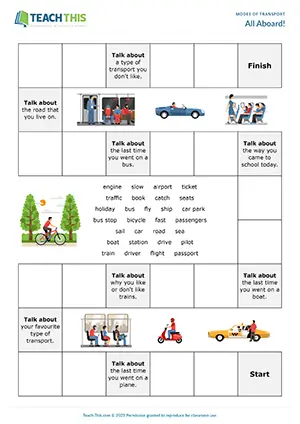
ESL Transport Vocabulary Board Game, elementary A1-A2, gap-fill, guessing, group work

ESL Transport Vocabulary Board Game - Vocabulary and Speaking: Gap-fill, Guessing, Impromptu Speech, Freer Practice - Group Work

Here is an enjoyable transport vocabulary board game to help students practice vocabulary related to modes of transport. In groups, students take turns...

ESL Transport Vocabulary Board Game - Vocabulary and Speaking: Gap-fill, Guessing, Impromptu Speech, Freer Practice - Group Work Here is an enjoyable transport vocabulary board game to help students practice vocabulary related to modes of transport. In groups, students take turns picking up a card and reading the sentence to the other students using the word 'blank' for the missing transport word, e.g. 'My mother drove me to school in her new BLANK.' The other students listen to the sentence and race to choose a word from the game board and say it aloud to complete the sentence, e.g. car. The first student to say the correct word shown on the card rolls the dice and moves their counter along the board. If a student lands on a 'Talk about' square, they talk about that topic to remain on the square. If they are unsuccessful, they move back one space. The first student to reach the finish wins the game. As a variation, students take turns trying to complete a sentence with a word from the board rather than racing each other.

On the Move

Elementary (A1-A2) 30 minutes
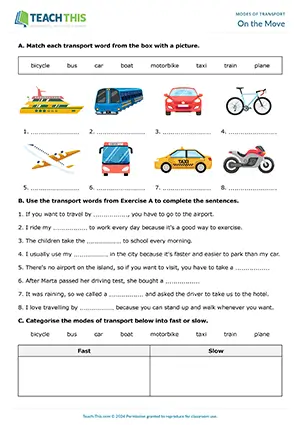
ESL Modes of Transport Worksheet, elementary A1-A2, matching, gap-fill, conversation

ESL Modes of Transport Worksheet - Vocabulary Exercises: Matching, Gap-fill, Categorising - Speaking Activity: Asking and Answering Questions, Freer Practice

This rewarding modes of transport worksheet helps students practice common transport-related vocabulary. First, students match transport words from a box...

ESL Modes of Transport Worksheet - Vocabulary Exercises: Matching, Gap-fill, Categorising, Binary Choice - Speaking Activity: Asking and Answering Questions, Freer Practice This rewarding modes of transport worksheet helps students practice common transport-related vocabulary. First, students match transport words from a box with pictures. Students then use the transport words to complete sentences. Next, students categorise modes of transport into fast or slow. After that, students underline the correct transport-related word or phrase to complete each sentence. Students then write down two answers for each transport-related item and then compare their answers with a partner. Following that, students rank modes of transport from their most favourite (1) to their least favourite (8), writing down the reason for their number 1 and 8 choice. Lastly, students ask and answer transport-related conversation questions with a partner.

Transport Survey

Elementary (A1-A2) 20 minutes
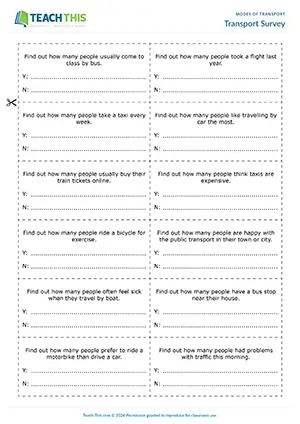
ESL Transport Activity, elementary A1-A2, yes/no survey, group work

ESL Transport Activity - Speaking: Forming, Asking and Answering Questions - Group Work

In this insightful modes of transport speaking activity, students conduct a survey where they ask and answer yes/no questions about transport. First, each student creates a yes/no transport question from...

ESL Transport Activity - Speaking: Forming, Asking and Answering Questions from Prompts - Group Work In this insightful modes of transport speaking activity, students conduct a survey where they ask and answer yes/no questions about transport. First, each student creates a yes/no transport question from a prompt on a card, e.g. 'Do you usually come to class by bus?' Students then go around their group, asking and answering the transport-related questions, noting the number of people who answer yes or no to their question on the card. Afterwards, each student reports their findings to the class, e.g. 'Five people usually come to class by bus.'

Get Moving!

Pre-intermediate (A2) 25 minutes
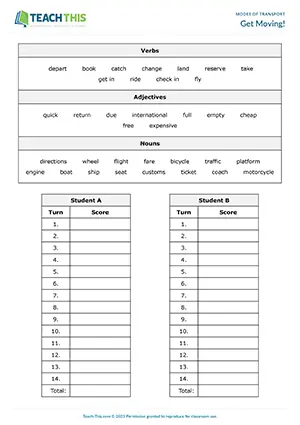
ESL Transport Vocabulary Game, pre-intermediate A2, gap-fill, verbs, adjectives, nouns, pair work

ESL Transport Vocabulary Game - Vocabulary: Guessing, Gap-fill - Pair Work

In this free transport vocabulary game, students complete sentences with transport-related verbs, adjectives, and nouns. In pairs, students take turns picking up a card and reading out the gap-fill sentence to their partner using the word...

ESL Transport Vocabulary Game - Vocabulary: Guessing, Gap-fill - Pair Work In this free transport vocabulary game, students complete sentences with transport-related verbs, adjectives, and nouns. In pairs, students take turns picking up a card and reading out the gap-fill sentence to their partner using the word 'blank' for the missing word. Their partner then has one chance to guess the missing word by choosing a transport-related verb, adjective or noun from the game board and saying it in its correct form. If the student guesses the correct transport word in its correct form, they give themselves one point and write it in the appropriate column on the game board. If the student guesses the wrong word or gives the wrong word form, no points are awarded for that turn. Play continues until all the cards have been read out and guessed. The student with the most points wins the game.

Hit the Road

Pre-intermediate (A2) 25 minutes
ESL Modes of Transport Games, pre-intermediate A2, pelmanism, matching, forming sentences, pair work

ESL Modes of Transport Games - Vocabulary: Pelmanism, Matching, Forming Sentences, Categorising - Pair Work

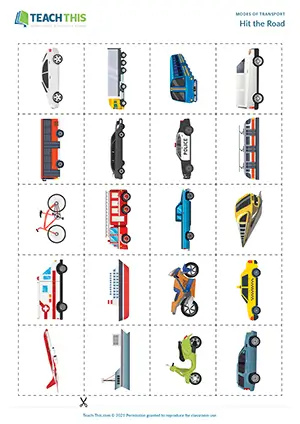
These fun modes of transport games help introduce students to transport vocabulary. In pairs, students begin by playing a pelmanism game where they take it in turns to turn over one picture card and one...

ESL Modes of Transport Games - Vocabulary: Pelmanism, Matching, Forming Sentences, Categorising - Pair Work These fun modes of transport games help introduce students to transport vocabulary. In pairs, students begin by playing a pelmanism game where they take it in turns to turn over one picture card and one word card. If the picture and word match, the student reads the mode of transport aloud, keeps the two cards and has another turn. The student with the most pairs of cards at the end wins. Students then move on to play a snap-style game with the cards. One student takes all the picture cards and the other takes the word cards. Both students turn over a card from their pile at the same time. If the two cards match, the first student to say 'Snap' scores a point. For an extra point, the student then tries to make a sentence about the mode of transport, e.g. 'I came to school by car'. The two students then pick up their own cards, shuffle them and play again. The first student to get 15 points wins the game. Finally, pairs categorize the modes of transport into four types: public transport, personal transport, emergency vehicles and goods vehicles.

Let's Learn about Transport

Intermediate (B1) 20 minutes
ESL Modes of Transport Worksheet, intermediate B1, matching, categorising, sentence completion

ESL Modes of Transport Worksheet - Vocabulary Exercises: Matching, Categorising, Sentence Completion, Gap-fill

This informative modes of transport worksheet helps students learn and practice transport vocabulary and related verb collocations. Students begin by matching modes of transport with...

ESL Modes of Transport Worksheet - Vocabulary Exercises: Matching, Categorising, Sentence Completion, Gap-fill This informative modes of transport worksheet helps students learn and practice transport vocabulary and related verb collocations. Students begin by matching modes of transport with pictures. Next, students categorize the modes of transport, according to the verbs or phrasal verbs they can be used with. Students then complete sentences with the verbs or phrasal verbs and modes of transport by looking at the place stated at the beginning of each sentence. Finally, students do a gap-fill exercise where they complete sentences with verbs or modes of transport based on the context of each sentence.

The Tabarca Island Ferry

Intermediate (B1) 30 minutes
ESL Public Transport Worksheet, intermediate B1, unscrambling, matching, gap-fill, pair work

ESL Public Transport Worksheet - Vocabulary and Reading Exercises: Matching, Gap-fill - Speaking Activity: Asking and Answering Questions - Pair Work

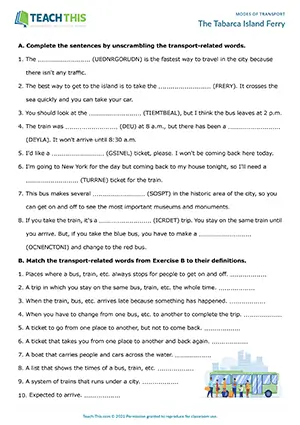
This comprehensive public transport worksheet helps students learn and practice vocabulary commonly required for using public transport. First...

ESL Public Transport Worksheet - Vocabulary and Reading Exercises: Unscrambling, Matching, Gap-fill - Speaking Activity: Asking and Answering Questions - Pair Work This comprehensive public transport worksheet helps students learn and practice vocabulary commonly required for using public transport. First, students complete sentences by unscrambling public transport words. Next, students match the public transport words to their definitions. After that, students complete a dialogue at a tourist information office using words from a box. Following that, students use the words to complete public transport questions. Finally, in pairs, students ask and answer the questions, giving as much detail as possible.

Transportation Crossword

Intermediate (B1) 30 minutes
ESL Modes of Transport Crossword, intermediate B1, writing clues, describing, guessing

ESL Modes of Transport Crossword - Vocabulary Activity: Writing Clues, Describing, Guessing - Pair and Group Work

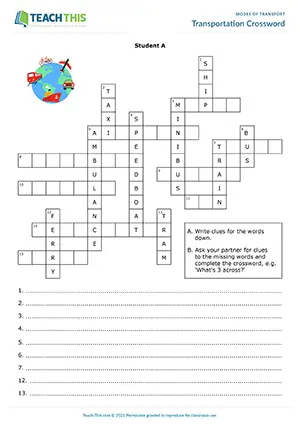
In this free modes of transport crossword activity, students complete a crossword by describing and guessing different modes of transport. In two groups, students work together to invent and...

ESL Modes of Transport Crossword - Vocabulary Activity: Writing Clues, Describing, Guessing - Pair and Group Work In this free modes of transport crossword activity, students complete a crossword by describing and guessing different modes of transport. In two groups, students work together to invent and write down clues for the modes of transport written on their crossword. Next, students pair up with someone from the other group and take it in turns to ask their partner for a clue to one of their missing words. Their partner reads out the clue for that word and the other student tries to guess the mode of transport. If the student guesses the word successfully, they write it on their crossword. If not, their partner continues to give more clues until the student is able to guess the word.

How was your Journey?

Upper-intermediate (B2) 30 minutes
ESL Transportation Adjectives Game, upper-intermediate B2, matching, pair work

ESL Transportation Adjectives Game - Vocabulary: Matching - Pair Work

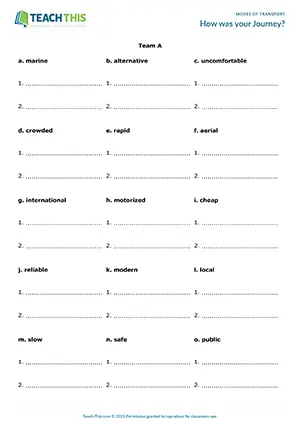
In this engaging transportation adjectives game, students guess transportation adjectives from modes of transport. Write the transportation adjectives from the worksheet on the board and review the meaning of each adjective with the class...

ESL Transportation Adjectives Game - Vocabulary: Matching - Pair Work In this engaging transportation adjectives game, students guess transportation adjectives from modes of transport. Write the transportation adjectives from the worksheet on the board and review the meaning of each adjective with the class. In pairs, students then write two types of transport that best describe each adjective. When the pairs have finished, they take it in turns to read out the two modes of transport for each adjective to another pair who listens and has one chance to guess the transportation adjective. If the pair guesses correctly, they score a point. Students are also encouraged to give feedback on the two modes of transport for each adjective and say whether they agree with the answers or not. The pair with the most points at the end of the game wins.

Setting Sail

Upper-intermediate (B2) 30 minutes
ESL Boat Travel Worksheet, upper-intermediate B2, matching, gap-fill, true or false, pair work

ESL Boat Travel Worksheet - Vocabulary Exercises: Matching, Gap-fill, Categorising, Writing Answers - Speaking Game: True or False, Guessing - Pair Work

In this useful boat travel worksheet, students learn boat vocabulary and practice talking about travelling by boat. First, students match each type of boat to its...

ESL Boat Travel Worksheet - Vocabulary Exercises: Matching, Gap-fill, Categorising, Writing Answers - Speaking Game: True or False, Guessing - Pair Work In this useful boat travel worksheet, students learn boat vocabulary and practice talking about travelling by boat. First, students match each type of boat to its correct definition. Next, students match each verb related to boat travel to the correct definition and complete sentences with the verbs in their correct form. After that, students categorize other boat-related vocabulary under the correct headings and complete sentences with the words. In the last exercise, students play a true or false game. Students answer questions about their last trip on a boat by writing either all true or all false information. Then, in pairs, students ask their partner the questions on the worksheet and guess if they are lying or telling the truth.

Using Transport Vocabulary

Transport vocabulary names the vehicles people use and describes how they travel. Combining these words with suitable verbs and prepositions helps students explain journeys, compare travel options and discuss their preferences.

This page offers 13 resources from beginner (A1) to upper-intermediate (B2), including two free downloads. The materials cover vehicle names, transport collocations, public transport and language for describing journeys.

Use the examples below to connect transport words with practical travel situations.

PurposeUseful languageExample
Name a means of transport bus, train, bicycle, ferry 'A ferry carries passengers across the water.'
Explain how you travel by bus, by car, on foot 'I go to work by bus.'
Describe travel actions catch a train, ride a bike, drive a car 'She rides her bike to college.'
Talk about boarding get on a bus, get off a train, get into a taxi 'We got on the bus outside the station.'
Discuss public transport ticket, fare, timetable 'Check the timetable before you leave.'
Compare travel options comfortable, crowded, reliable 'The train is comfortable, but it can be crowded.'

How to Use Transport Vocabulary

Connect names with actions: After students identify a vehicle, ask them to use it in a sentence about travelling. Build from 'a bicycle' to 'ride a bicycle' and then 'I ride my bicycle to school' so naming leads to usable language.

Give travel choices a context: Set a destination and a reason for travelling before asking students to compare options. Encourage them to explain a choice using time, cost or comfort rather than simply listing transport adjectives.

Prepare for practical exchanges: For public transport practice, establish what information a traveller needs, such as a departure time or fare. Model a short question and answer before students create similar exchanges with new details.

3-Step Framework for Teaching Transport Vocabulary

For beginners, move from recognising transport names to recalling them and interpreting short descriptions. The following sequence uses the page's beginner resources.

1. Establish names and pronunciation: Show transport flashcards, elicit each name and model pronunciation. Students then match words to pictures and complete sentences on a worksheet. This gives them a visual reference and written practice before they need to recognise the words by listening.

2. Link listening with recall: Call out transport names while students mark matching pictures on bingo cards and say the words aloud. Have a winning student read back the completed card. This checks recognition and spoken recall before students work with descriptions instead of names.

3. Identify transport from clues: In pairs, students read clue cards and guess the vehicle using 'It is a/an...'. A correct answer after the first clue earns two points; the second clue offers another chance for one point. This moves practice from recognising a label to understanding what distinguishes each vehicle.

Common Mistakes with Transport Vocabulary

Adding an article after 'by': When naming a general means of transport, use 'by' without an article. Incorrect: 'I travel by a bus.' Correct: 'I travel by bus.' To describe being aboard a particular bus, use 'on the bus'.

Confusing 'travel' and 'journey': Use 'journey' for a particular movement from one place to another. 'Travel' is normally uncountable when referring to the general activity. Incorrect: 'We had a long travel to the airport.' Correct: 'We had a long journey to the airport.'

Common Questions About Teaching Transport Vocabulary

What worksheet can I use for teaching modes of transport?

On the Move introduces transport words through picture matching and sentence completion. Students then categorise transport, choose suitable words and phrases, and compare answers with a partner. Ranking their preferred modes of transport and answering conversation questions helps them connect the vocabulary with their own travel choices.

How can students practice describing modes of transport?

The free Transportation Crossword activity gives students a reason to describe transport clearly. Groups prepare clues for the words on their crossword, then students work with a partner from the other group. They exchange clues to complete the missing words, adding further details when a partner cannot guess.

What game helps students practice transport vocabulary?

The free game Get Moving! practices transport-related verbs, adjectives and nouns through sentence clues. Students read a sentence with a missing word to a partner, who chooses an answer from the board and gives its correct form. Correct answers earn points, so both meaning and word form matter.

Become a Teach This Member

Get unlimited access to the full library, plus new resources added every week.

Unlimited Resource Access

Download from 3000+ worksheets, activities, and games.

Save 5+ Hours Weekly

Cut lesson prep time with ready-to-use resources, plus teacher notes and answer keys.

Trusted Professional Quality

Classroom-tested, editable resources created by experienced ESL professionals.

Fresh Content Weekly

Get 5 new resources added to the library each week.

Join Now Just $29.99 quarterly