
Present Simple Yes/No Questions ESL Activities, Games & Worksheets
Do and Does Question Time
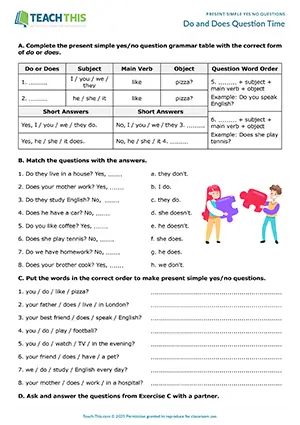
ESL Do and Does Questions Worksheet - Grammar Exercises: Matching, Ordering - Speaking Activities: Asking and Answering Questions, Freer Practice
In this present simple yes/no questions worksheet, students practice yes/no questions and short answers in the present simple with 'do' and 'does'...
Do or Does?

ESL Do and Does Questions Worksheet - Grammar Exercises: Gap-fill, Writing Questions and Answers - Speaking Activity - Asking and Answering Questions
This comprehensive 'do' and 'does' questions worksheet can be used to practice present simple yes/no questions and short answers. First, students complete...
Do you know me?

ESL Do You Questions Game - Grammar and Speaking: Completing, Asking and Answering Questions, Guessing - Pair Work
In this fun present simple guessing game, students get to know a partner while practicing forming, asking and answering questions with 'Do you...?' First, students complete present simple...
Find me

ESL Present Simple Yes No Questions Activity - Grammar, Speaking and Writing: Asking and Answering Questions, Writing Sentences, Freer Practice
In this engaging present simple yes/no questions activity, students practice asking and answering questions with the verbs 'be' and 'do' to find the classmate...
Questions, Questions

ESL Do and Does Questions Game - Grammar, Writing and Speaking: Writing, Asking and Answering Questions - Group Work
In this entertaining present simple yes/no questions game, students practice forming questions with 'do' and 'does' and responding with short answers. First...
Quick Question Snap

ESL Do and Does Questions Game - Grammar: Snap, Matching - Pair Work
In this fast-paced present simple game, students play snap by matching yes/no questions to short answers with 'do', 'does', 'don't' and 'doesn't'. In pairs, both students turn over a card from their pile at the same time and place the cards...
To Be and Do Questions
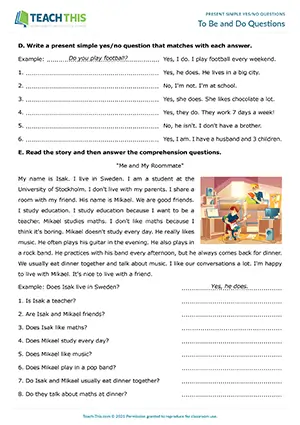
ESL Present Simple Yes/No Questions Worksheet - Grammar Exercises: Error Correction, Writing Questions, Gap-fill - Speaking Activity - Pair Work
In this useful present simple yes/no questions worksheet, students practice yes/no questions and short answers in the present simple with the verbs 'to be'...
True for You?

ESL Do You Questions Game - Grammar and Speaking: Guessing, Asking and Answering Questions, Freer Practice
In this rewarding 'Do you...?' questions game, students choose classmates who they think sentences are true for and then ask 'Do you...?' questions to check if their guesses are right or wrong. First...
Yes or No?
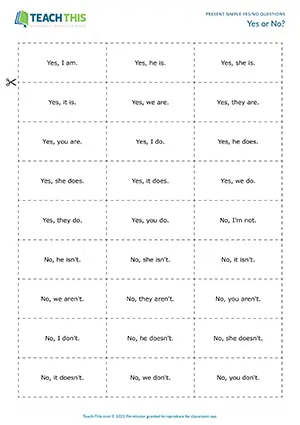
ESL Present Simple Yes No Questions Game - Grammar and Speaking: Forming, Asking and Answering Questions - Group Work
In this free present simple yes/no questions game, students practice yes/no questions and short answers with the verbs 'be' and 'do' by trying to make questions that match the short answers on their cards...
Daily Routines

ESL Present Simple Yes No Questions Activity - Grammar and Speaking: Writing Sentences, Guessing, Asking and Answering Questions - Pair Work
In this interesting present simple yes/no questions speaking activity, students ask and answer yes/no questions about their daily routine and the daily routine...
Does he/she...?

ESL Does Questions Activity - Grammar, Speaking and Writing: Asking and Answering Questions, Writing Sentences - Pair Work
In this free does yes/no questions activity, students practice asking and answering yes/no questions in the third-person singular. Students start by writing the...
Do you live in Singapore?

ESL Present Simple Yes No Questions Activity - Grammar and Reading Exercises: Writing Questions - Speaking Activity: Asking and Answering Questions - Pair Work
Here is a productive present simple yes/no questions activity to help students practice yes/no questions with the verb 'to be' and 'do'. First, in two groups...
Find Someone Who...
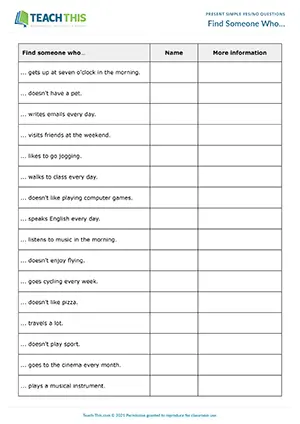
ESL Do You Questions Activity - Grammar and Speaking: Asking and Answering Questions
In this present simple yes/no questions speaking activity, students ask and answer present simple questions with 'Do you...?' in order to find out about their classmates' habits and routines...
Is it true?

ESL Do You Questions Activity - Grammar and Speaking: Asking and Answering Questions
In this insightful present simple yes/no questions speaking activity, students ask 'Do you...?' questions to find out if certain statements are true or false about the class. Give each student a statement...
Who wrote it?
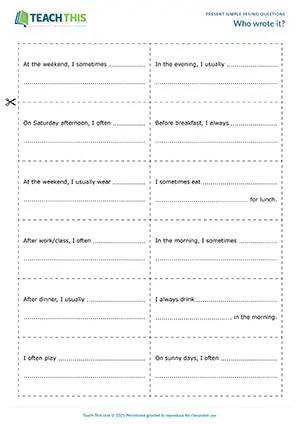
ESL Do You Questions Game - Grammar and Speaking: Sentence Completion, Forming, Asking and Answering Questions
This memorable 'Do you...?' questions game helps students to practice asking present simple yes/no questions about routine activities. The game also helps students practice various adverbs...
Work it out

ESL Present Simple Yes No Questions Activity - Grammar, Speaking and Writing: Asking and Answering Questions, Writing Short Paragraphs - Pair Work
In this intriguing present simple yes/no questions activity, students ask yes/no questions in the third-person singular to find out what short answers on...
Find a Roommate
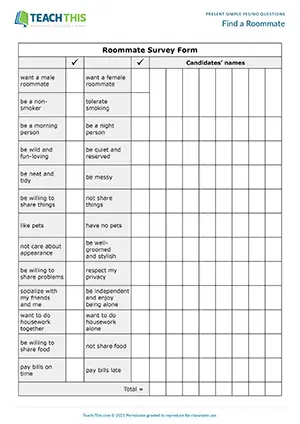
ESL To Be and Do Questions Activity - Grammar and Speaking: Forming, Asking and Answering Questions, Table Completion
In this inventive present simple yes/no questions speaking activity, students establish their own criteria for finding a compatible roommate and then ask and answer present simple yes/no questions with...
Secret Identities
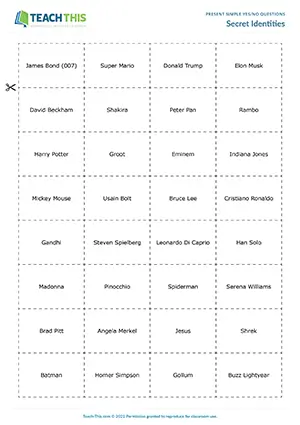
ESL Present Simple Yes No Questions Game - Grammar and Speaking: Forming, Asking and Answering Questions, Guessing - Pair Work
In this rewarding present simple yes/no questions game, students ask yes/no questions with the verb 'to be' and 'do' to find out their secret identities...
Understanding Present Simple Yes/No Questions
Present simple yes/no questions expect a yes or no answer, using do or does before the subject for action verbs, as in 'Do you work on Saturdays?', or moving the verb to be to the front, as in 'Are you a student?' When students skip the auxiliary or use the wrong one, the result sounds like a statement with a question mark rather than a real question, which can confuse a listener and make the speaker sound far less fluent than they actually are.
This page covers present simple yes/no questions across A1-A2 and B1 levels, with 18 activities including worksheets, card games, speaking activities, and group games, with two free downloads.
This table shows how to form present simple yes/no questions and short answers with do/does and the verb to be across all subject pronouns.
| Question Type | Structure | Example Question | Short Answer Yes | Short Answer No |
|---|---|---|---|---|
| do (I/you/we/they) | Do + subject + base verb + ...? | 'Do you speak English?' | Yes, I/you/we/they do. | No, I/you/we/they don't. |
| does (he/she/it) | Does + subject + base verb + ...? | 'Does she work here?' | Yes, he/she/it does. | No, he/she/it doesn't. |
| to be (I) | Am + I + adjective/noun + ...? | 'Am I late?' | Yes, you are. | No, you aren't. |
| to be (you/we/they) | Are + subject + adjective/noun + ...? | 'Are you ready?' | Yes, I am. / Yes, we/they are. | No, I'm not. / No, we/they aren't. |
| to be (he/she/it) | Is + subject + adjective/noun + ...? | 'Is he your teacher?' | Yes, he/she/it is. | No, he/she/it isn't. |
When to Use Present Simple Yes/No Questions
Checking facts quickly in conversation: Speakers use present simple yes/no questions when they need to confirm a fact quickly without asking for a full explanation, making them the natural choice when opening a conversation or checking a situation, as in 'Is the meeting still on?'
Expressing surprise or disbelief: In informal spoken English, a speaker often echoes information just received as a present simple yes/no question to show surprise, inviting the other person to confirm or correct, as in 'Does she really earn that much?'
Interviewing and gathering information: Present simple yes/no questions give interviewers and researchers a controlled way to gather comparable answers from multiple people, since every respondent gives the same form of answer, as in 'Do you use public transport every day?'
3-Step Framework for Teaching Present Simple Yes/No Questions
1. Start with Structure, Then Get Students Moving: Elementary students need a clear map of the forms before they can produce them confidently. A worksheet that moves from completing a grammar table with do, does, don't and doesn't through matching and reordering gives students that map systematically. The energy shifts when students stand up for a class mingle, going around asking 'Do you...?' questions from prompts and writing down the name of every classmate who answers 'Yes, I do.'
2. Make Accuracy Count with a Team Scoring Game: Once students can form the questions, put the pressure on with a team game that rewards both sides of the exchange. In teams of two, students form 20 present simple yes/no questions from subjects and actions on their worksheet, then fire them at another team. A grammatically correct question earns two points and a grammatically correct short answer from the other team earns one point. Answers do not need to be true, and teams only get one chance to answer correctly, so every student has to stay sharp.
3. Push into Real Decision-Making: At intermediate level, yes/no questions become a tool for a genuinely communicative task. Students establish their own criteria for finding a compatible roommate by considering each pair of statements and putting a tick next to the one that best expresses their view. They then use that personal criteria to interview classmates with present simple yes/no questions using both to be and do, narrowing the field to the most suitable candidate.
Common Mistakes with Present Simple Yes/No Questions
Using doesn't instead of don't in short answers: Students often reply with doesn't when the subject is I, you, we, or they, applying the third-person form to all negative short answers regardless of subject. Wrong: 'No, I doesn't.' Correct: 'No, I don't.'
Using do or does with the verb to be: Students often add do or does before the verb to be in a yes/no question, not realizing that to be forms questions by moving to the front of the sentence on its own without an auxiliary. Wrong: 'Do you are a teacher?' Correct: 'Are you a teacher?'
Common Questions About Teaching Present Simple Yes/No Questions
What is a quick present simple yes/no questions game for elementary students?
The free game Yes or No? gives elementary students immediate practice forming yes/no questions with both do and to be. Players take turns choosing a short answer card without showing it, thinking of a question that will produce that answer, then asking it to another student. The first player to discard all their cards wins.
What present simple yes/no questions worksheet covers both do/does and to be for elementary students?
Elementary students need to see both question types side by side. The worksheet To Be and Do Questions, suitable for A1-A2 students, moves from error correction and gap-fill through to writing questions from prompts, before students interview a partner and write four sentences about them to read to the class.
What is a creative present simple yes/no questions activity for pre-intermediate students?
Student-written cards give yes/no questions a real communicative purpose. In the game Who wrote it?, an A2 activity, students complete present simple sentence cards with true information, put them in a box, draw a card, and go around asking questions like 'Do you sometimes go fishing with your friend at the weekend?' until they find the classmate who wrote it.
Become a Teach This Member
Get unlimited access to the full library, plus new resources added every week.
Unlimited Resource Access
Download from 3000+ worksheets, activities, and games.
Save 5+ Hours Weekly
Cut lesson prep time with ready-to-use resources, plus teacher notes and answer keys.
Trusted Professional Quality
Classroom-tested, editable resources created by experienced ESL professionals.
Fresh Content Weekly
Get 5 new resources added to the library each week.
Here's what our members are saying...


