
Subject-Verb Agreement ESL Games, Worksheets & Activities
Emma's Neighbours

ESL Subject-Verb Agreement Activities - Grammar Exercises: Gap-fill, Writing Sentences - Speaking Activity: Information Gap - Pair Work
This productive subject-verb agreement information gap activity helps students practice subject-verb agreement in the present simple. First...'
Fun with Verbs

ESL Subject-Verb Agreement Worksheet - Grammar Exercises: Matching, Writing Sentences - Speaking Game: Forming Sentences - Pair Work
In this free subject-verb agreement worksheet and game, students build accuracy by matching verbs and nouns and forming short present simple sentences...
Sentence Tic-Tac-Toe
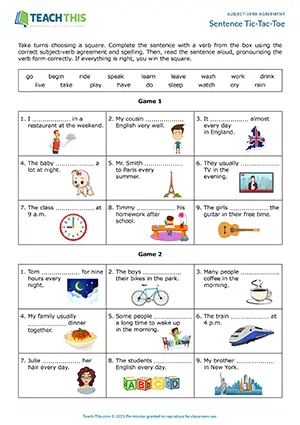
ESL Subject-Verb Agreement Game - Grammar and Pronunciation: Gap-fill - Pair Work
In this engaging subject-verb agreement game, students play Tic-Tac-Toe by completing present simple sentences with verbs and pronouncing verb forms correctly. In pairs, students take turns...
Who are you?
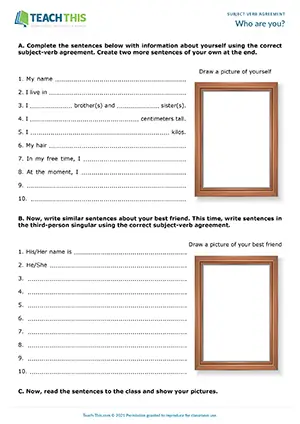
ESL Subject-Verb Agreement Worksheet - Grammar Exercises: Gap-fill, Writing Sentences, Drawing
Here is a useful subject-verb agreement worksheet to help students practice present simple subject-verb agreement in the first and third-person. First, students complete sentences by writing verbs...
Let's Practice

ESL Subject-Verb Agreement Worksheet - Grammar Exercises: Gap-fill, Changing Word Forms, Writing Sentences, Controlled and Freer Practice - Pair Work
This insightful subject-verb agreement worksheet is ideal for practicing or reviewing present simple subject-verb agreement. Students start by completing...
Match it up

ESL Subject-Verb Agreement Game - Grammar: Matching - Pair Work
In this fun subject-verb agreement game, students match subjects, verbs and objects together to make sentences. The first student turns over one subject card, one verb card and one object card in order. If the three cards match to make a...
Run and Write
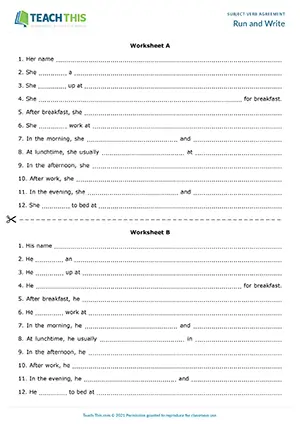
ESL Subject-Verb Agreement Activity - Grammar, Reading and Writing: Running Dictation, Sentence Completion - Pair Work
Here is a free subject-verb agreement running dictation activity that offers extensive practice of third-person singular subject-verb agreement in the present simple. One student is the reader and the other...
Subject and Verb Draughts
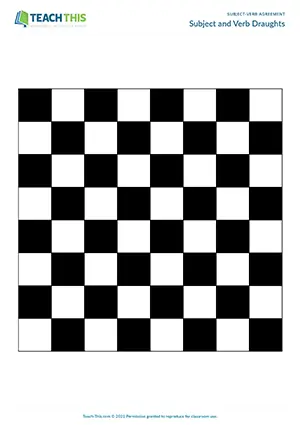
ESL Subject-Verb Agreement Game - Grammar and Speaking: Matching, Forming Sentences - Pair Work
Here is an interesting subject-verb agreement game for students to play in class. In the game, students play subject-verb agreement draughts using subject and verb counters. A singular or plural subject...
Race Me
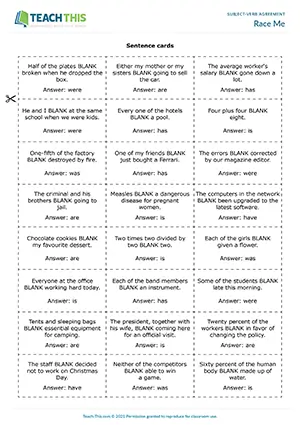
ESL Subject-Verb Agreement Game - Grammar and Listening: Matching - Group Work
In this entertaining subject-verb agreement game, students race to complete sentences with the correct subject-verb agreement. The reader turns over a card and reads the sentence aloud to the...
Sentence Challenge
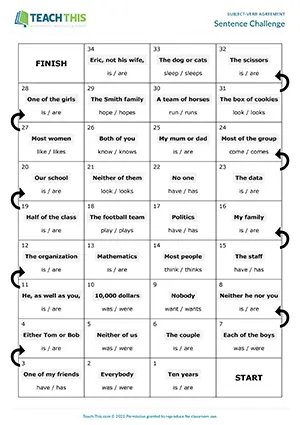
ESL Subject-Verb Agreement Board Game - Grammar and Speaking: Forming Sentences, Controlled and Freer Practice - Group Work
In this challenging subject-verb agreement board game, students combine subjects and verbs together to form grammatically correct sentences. Players take turns rolling the dice and moving their counter...
Understanding Subject-Verb Agreement
Subject-verb agreement is the rule that a verb must match its subject in number: a singular subject takes a singular verb form, and a plural subject takes a plural verb form. Students who ignore this rule produce sentences like 'She walk to school every day,' which immediately signals to a reader that the writer has not yet mastered one of the most basic patterns in English.
This page covers subject-verb agreement across A1-A2, A2, and B1 levels, with ten resources including games, worksheets, an information gap activity, and a running dictation, two of which are available as free downloads.
The table below shows how verb forms change with each subject across the present simple, past simple, present perfect, and future simple at A1-B1 level.
| Subject | Present Simple | Past Simple | Present Perfect | Future Simple (will) | Example (Present Simple) |
|---|---|---|---|---|---|
| I | work | worked | have worked | will work | 'I work in an office.' |
| You | work | worked | have worked | will work | 'You work in an office.' |
| He / She / It | works | worked | has worked | will work | 'She works in an office.' |
| We | work | worked | have worked | will work | 'We work in an office.' |
| They | work | worked | have worked | will work | 'They work in an office.' |
When to Use Subject-Verb Agreement
Collective Noun Clarity: When the subject is a group noun such as team, committee, or staff, choosing a singular or plural verb signals whether the group acts as one unit or as separate individuals, for example 'The committee agrees on the decision' tells a reader the group reached a unanimous conclusion, while 'The committee are arguing among themselves' tells the reader they have not.
Indefinite Pronoun Agreement: Indefinite pronouns such as everyone, nobody, and someone always take a singular verb even though they refer to multiple people, and a writer who uses a plural verb loses precision and sounds less assured in formal contexts, for example 'Everyone is welcome to attend.'
Signalling Quantity with There Is/There Are: Choosing between there is and there are depends entirely on whether the noun that follows is singular or plural, and getting it wrong causes a reader to misread the quantity being described, for example 'There are three options available, but there is only one correct answer.'
3-Step Framework for Teaching Subject-Verb Agreement
1. Build the Form with a Worksheet and Game: Start at A1-A2 level with a worksheet that has students match verbs to nouns before writing present simple sentences with different subject pronouns. The competitive game that follows is where the form really locks in: call out a verb and a subject pronoun, and pairs race to build a correct sentence using a noun from the worksheet, so that write + I becomes 'I write an email.' The first pair to raise their hands and say a correct sentence scores the point.
2. Add Physical Energy with a Running Dictation: Shift the focus to third-person singular agreement at A2 level with a running dictation in which one student is the reader and the other is the writer. The writer reads out the opening of a gapped sentence, for example 'Her name...', while the reader sprints to a text about someone's daily routine, memorises the missing information, runs back, and tells the writer, who then completes the sentence using the correct third-person singular form. Pairs race each other to finish all twelve sentences first.
3. Push into Freer Production with a Board Game: Take students to B1 level with a board game where every square presents a subject and two verbs, and players must choose the correct one and produce a full sentence on the spot. The penalty mechanic sharpens focus: if the subject-verb agreement or sentence is incorrect, the player goes back two squares, so accuracy directly controls progress around the board.
Common Mistakes with Subject-Verb Agreement
Agreeing with the Wrong Noun After a Phrase: Students often make the verb agree with the nearest noun in a phrase that sits between the subject and the verb, rather than with the actual subject of the sentence. Wrong: 'The list of requirements are on the table.' Correct: 'The list of requirements is on the table.'
Agreement Errors with Or/Nor Subjects: Students often treat two subjects joined by or or nor as a plural and use a plural verb throughout, when the verb should agree with whichever subject sits closest to it. Wrong: 'Neither the manager nor the assistants was available.' Correct: 'Neither the manager nor the assistants were available.'
Common Questions About Teaching Subject-Verb Agreement
What is an engaging subject-verb agreement game for elementary students?
Competition sharpens attention at A1-A2 level. In the game Sentence Tic-Tac-Toe, students complete present simple sentences with verbs and pronounce verb forms correctly to claim a square. What makes it competitive is the steal rule: if a student gets the verb form, spelling, or pronunciation wrong, their partner can steal the square by correcting it.
What is a useful subject-verb agreement worksheet for pre-intermediate students?
The worksheet Let's Practice gives pre-intermediate students structured practice across all three persons of the present simple. Students complete 20 sentences and questions in the first, second and third person with the correct form of the verbs in brackets, then write their own sentences using various subject pronouns and verbs, and check each other's work in pairs.
What is an effective subject-verb agreement activity for A1-A2 students?
Giving students a reason to produce sentences makes grammar practice stick at A1-A2 level. In the activity Emma's Neighbours, students ask and answer yes/no questions about neighbours and complete a chart with the missing information, then write present simple sentences about each neighbour. The activity ends with students deciding which neighbour Emma matches with the most and why.
Become a Teach This Member
Get unlimited access to the full library, plus new resources added every week.
Unlimited Resource Access
Download from 3000+ worksheets, activities, and games.
Save 5+ Hours Weekly
Cut lesson prep time with ready-to-use resources, plus teacher notes and answer keys.
Trusted Professional Quality
Classroom-tested, editable resources created by experienced ESL professionals.
Fresh Content Weekly
Get 5 new resources added to the library each week.
Here's what our members are saying...


