
Seasons ESL Games, Worksheets & Activities
Seasonal Sort-Out

ESL Four Seasons Games - Vocabulary: Matching, Labelling, Drawing, Memorizing, Guessing - Pair Work
In these free four seasons games, students match vocabulary with pictures related to the four seasons and play a memory game and guessing game using the seasonal vocabulary. First, students...
A Seasonal Match

ESL Seasons Vocabulary Games - Vocabulary and Speaking: Matching, Pelmanism, Forming Sentences, Controlled and Freer Practice - Pair Work
Here are two enjoyable seasons vocabulary games to help students practice words related to spring, summer, autumn and winter. First, students play a pelmanism...
Summer Collocation Dominoes

ESL Summer Vocabulary Game - Vocabulary: Matching, Forming Sentences - Group Work
In this engaging summer collocations game, students play dominoes by making sentences with collocations related to summer. The first player places one of their dominoes at one end of the domino on the table, pairing a verb with a summer word or...
The Four Seasons

ESL Seasons Worksheet - Vocabulary Exercises: Matching, Categorising, Gap-fill - Speaking Activity: Asking and Answering Questions, Freer Practice - Pair Work
This detailed four seasons worksheet helps students learn and practice vocabulary related to spring, summer, autumn and winter. First, students match each season...
Seasonal Survey

ESL Seasonal Habits Survery - Vocabulary and Speaking Activity: Sentence Completion, Asking and Answering Questions, Controlled and Freer Practice
In this insightful seasonal habits speaking activity, students conduct a survey about seasonal habits and preferences. First, students complete...
Secret Seasonal Word Game
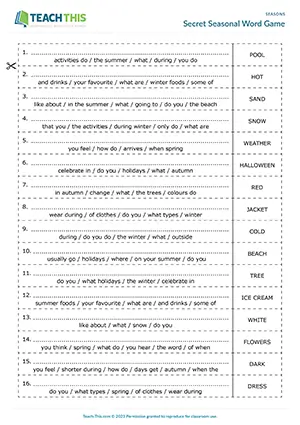
ESL Seasons Vocabulary Game - Speaking and Vocabulary: Unscrambling, Asking and Answering Questions, Guessing, Controlled and Freer Practice - Pair Work
In this productive seasons vocabulary game, students ask and answer season-related questions to try to elicit words related to seasons. In two groups...
Summer Vocabulary

ESL Summer Worksheet - Reading and Vocabulary Exercises: Categorising, Matching, Listing, Guessing
In this comprehensive summer vocabulary worksheet, students learn and practice common words associated with summer. To begin, students read a short text about summer and categorize...
Super Seasons
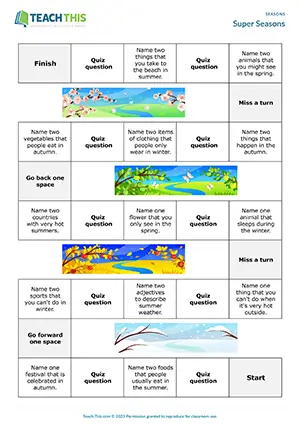
ESL Seasons Board Game - Vocabulary: Answering Quiz Questions, Multiple-Choice, Guessing - Group Work
Here is a fun seasons board game to help students practice or review vocabulary related to the four seasons. In groups, players take turns rolling the dice and moving their counter along the board. When a...
Autumn Vocabulary
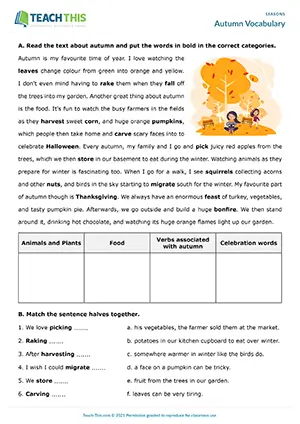
ESL Autumn Worksheet - Reading and Vocabulary Exercises: Categorising, Matching, Listing, Guessing
Here is a free autumn vocabulary worksheet to help teach students words related to the autumn season. First, students read a text about autumn and categorize autumn vocabulary from the text...
Race through the Snow

ESL Winter Board Game - Grammar and Vocabulary Game: Miming, Guessing, Forming Sentences - Group and Pair Work
In this entertaining winter board game, students perform winter-related mimes for a teammate to guess. In competing teams of two, students take it in turns to pick up a card and mime the winter activity...
Spring Vocabulary
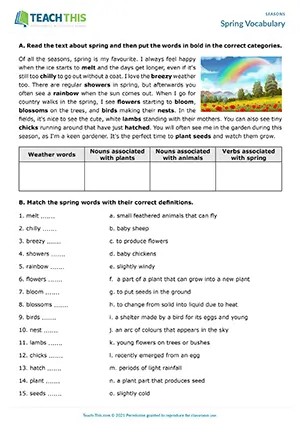
ESL Spring Worksheet - Vocabulary Exercises: Categorising, Matching, Gap-fill - Speaking Activity: True or False, Discussion - Pair Work
This useful spring vocabulary worksheet helps to teach students common words related to the spring season. To start, students read a short text about spring...
Winter Vocabulary

ESL Winter Worksheet - Vocabulary Exercises: Matching, Gap-fill, Sentence Completion - Listening and Speaking: Drawing and Describing - Pair Work
This handy winter vocabulary worksheet helps to teach students common words related to the winter season. Students start by matching each winter word to its...
Using Seasons Vocabulary
Seasons vocabulary describes the times of year and the weather, activities and changes associated with them. Using these words in context helps students explain seasonal routines and compare experiences in different places.
This page contains 12 resources from beginner (A1) to upper-intermediate (B2), including two free downloads. The materials cover the four seasons, seasonal activities, collocations and personal preferences.
The examples below illustrate useful combinations; seasonal conditions vary by location.
| Purpose | Useful language | Example |
|---|---|---|
| Name a season | spring, summer, autumn, winter | 'Autumn is my favourite season.' |
| Describe seasonal weather | warm, rainy, snowy, dry | 'Winters are dry where I live.' |
| Talk about activities | go camping, go skiing, plant flowers | 'We go camping in summer.' |
| Describe natural changes | flowers bloom, leaves fall, snow melts | 'The snow melts as the weather gets warmer.' |
| Explain a preference | prefer, enjoy, because | 'I prefer spring because I enjoy spending time outdoors.' |
| Compare places | wet season, dry season, warmer than | 'We have a wet season and a dry season.' |
How to Use Seasons Vocabulary
Start with local experience: Ask students what changes they notice during the year before introducing pictures of the four seasons. Explain that snow, falling leaves and particular holiday dates are not universal features of a season.
Teach actions alongside nouns: Build short combinations such as 'plant flowers' and 'go camping', then place them in sentences. Ask students to explain when they do these activities rather than treating each activity as belonging to only one season.
Extend preferences with reasons: Model a season choice followed by a reason about weather or activities. Have partners compare answers and ask a follow-up question so students practice responding to one another as well as naming seasons.
3-Step Framework for Teaching Seasons Vocabulary
For students around elementary to pre-intermediate level, move from recognising seasonal words to forming sentences and sustaining an exchange. The following sequence uses different resources from those recommended in the common questions.
1. Recognise words in context: Students match seasonal words with sentences containing gaps in a memory game, reading each completed sentence aloud. They then make new sentences from word prompts. This moves them from recognising a suitable answer to choosing their own context.
2. Strengthen verb combinations: Use a summer-themed domino task in which students join verbs with suitable words and make a sentence containing the resulting collocation. A domino stays in place only when the sentence is appropriate. This gives students practice building accurate phrases before using vocabulary in longer answers.
3. Develop answers through questions: Students put question words in order, then ask a partner seasonal questions to elicit a secret word. If the word does not appear, they ask follow-up questions. This gives both partners a reason to develop the exchange beyond a single short answer.
Common Mistakes with Seasons Vocabulary
Using 'on' before a season: Use 'in' when saying that something happens during a season. Incorrect: 'We go camping on summer.' Correct: 'We go camping in summer.' With 'this', 'next' or 'last', omit the preposition: 'We are going camping next summer.'
Using a weather noun after 'be': Choose an adjective to describe conditions or a verb to describe weather happening. Incorrect: 'It is snow today.' Correct: 'It is snowy today.' To describe falling snow, say 'It is snowing today.'
Common Questions About Teaching Seasons Vocabulary
What worksheet can I use for teaching the four seasons?
The worksheet The Four Seasons connects season names with pictures, descriptions and related vocabulary. Students sort words, choose suitable phrases and complete sentences before comparing their own examples with a partner. Final conversation questions move the language beyond recognition into talking about seasonal experiences and preferences.
How can students practice talking about the seasons?
The activity Seasonal Survey gets students comparing seasonal habits and preferences. They first complete statements with their own answers, then question classmates to find someone with the same response and someone with a different one. Reporting their findings gives students a reason to listen carefully and explain the differences.
What free games help students practice seasons vocabulary?
The free resource Seasonal Sort-Out combines picture matching with memory and guessing games. Students label seasonal pictures and draw an additional item for each season. Partners then recall vocabulary with their worksheets hidden and guess each other's drawings, practicing the words through both remembering and responding to another student's ideas.
Become a Teach This Member
Get unlimited access to the full library, plus new resources added every week.
Unlimited Resource Access
Download from 3000+ worksheets, activities, and games.
Save 5+ Hours Weekly
Cut lesson prep time with ready-to-use resources, plus teacher notes and answer keys.
Trusted Professional Quality
Classroom-tested, editable resources created by experienced ESL professionals.
Fresh Content Weekly
Get 5 new resources added to the library each week.
Here's what our members are saying...


